
What Documentation is Needed for export of Hardware from UK to EU?
A Practical Guide for Businesses
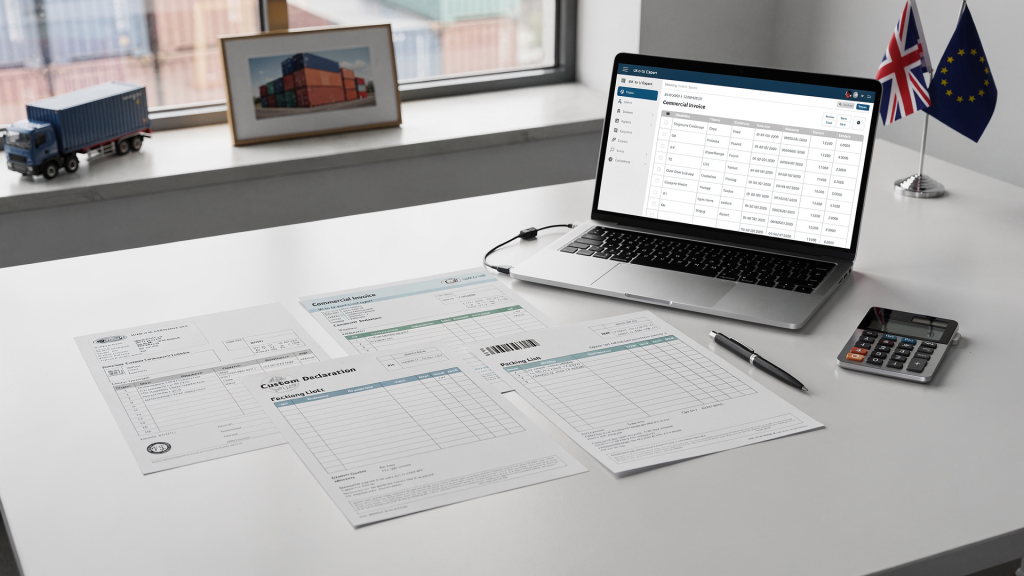
Export documentation UK to EU has become significantly more complex since Brexit, what used to be a routine shipment has become a process where a single missing detail can delay delivery, increase costs, or even stop goods at the border.
Many companies underestimate how complex UK–EU shipments have become post-Brexit, especially when it comes to official export requirements. And this is exactly where most problems begin.
Why documentation matters more than ever
When shipping hardware — whether electronics, IT equipment, or machinery — from the UK to the EU, customs authorities on both sides require precise, consistent, and complete documentation.
Even a minor inconsistency between documents can result in:
- shipment delays
- customs inspections
- unexpected duties or VAT charges
- additional storage and handling costs
Many businesses underestimate how complex export documentation UK to EU shipments have become post-Brexit. Documentation is no longer a formality — it is a critical part of the supply chain.
Key export documents required (UK → EU)
Below is a structured overview of the essential documents required when exporting hardware.
1. Commercial Invoice
This is the most important document in the entire process.
It must include:
- full seller and buyer details
- EORI numbers (UK and EU)
- detailed description of goods (not generic)
- HS (commodity) codes
- value of goods (accurate and realistic)
- Incoterms (e.g. DAP, DDP, EXW)
A vague description such as “hardware” is not acceptable. For example:
- instead of “electronics”, use “laptop computers, lithium battery included”
2. Packing List
Supports the commercial invoice and provides logistical clarity.
It should include:
- number of packages
- weight (net and gross)
- dimensions
- packaging type (pallets, boxes, crates)
Customs and transport partners rely on this to verify the shipment physically.
3. EORI Number
Both exporter (UK) and importer (EU) must have valid EORI numbers.
Without this:
- customs clearance is impossible
- shipments will be stopped immediately
4. Export Declaration (EX1)
Export Declaration (EX1) must be submitted in line with official UK export requirements.
This document:
- formally declares goods leaving the UK
- includes commodity codes, value, origin and destination
Usually handled by a customs broker or freight forwarder, but responsibility still lies with the exporter.
5. Import Declaration (EU side)
Import Declaration is required for entry into the EU and must comply with EU customs regulations.
Required for entry into the EU.
Key elements:
- correct HS codes
- customs value
- applicable duties and VAT
Errors here often result in unexpected costs for the receiver.
6. HS (Commodity) Codes
One of the most critical elements.
Incorrect HS codes can lead to:
- wrong duty rates
- shipment delays
- compliance issues
For hardware and electronics, classification can be complex due to:
- components
- dual-use items
- integrated technologies
7. Certificate of Origin (if applicable)
Used to determine whether goods qualify for preferential tariffs under the EU–UK Trade and Cooperation Agreement.
Incorrect origin declarations can result in:
- loss of duty benefits
- financial penalties
The most common mistakes companies make
Many of these issues can be avoided with properly structured export documentation UK to EU.
In practice, most shipment issues are not caused by regulations — but by avoidable errors.
Inconsistent information
Different values, weights, or product descriptions across documents.
Incorrect Incoterms
Many companies use Incoterms without understanding cost and responsibility implications.
For example, DDP without proper tax handling can create serious complications.
Poor product descriptions
Generic descriptions increase the likelihood of customs inspections.
Missing or incorrect HS codes
One of the most frequent and costly mistakes.
Lack of coordination
Export, transport, and import handled by different parties without alignment.
These issues often arise from poorly managed export documentation UK to EU, where consistency and accuracy are critical.
What delays actually cost your business
Delays are not just operational inconveniences. They directly affect:
- client satisfaction
- contractual obligations
- cash flow
- reputation
A shipment held at the border for 2–3 days can generate:
- storage fees
- demurrage
- reprocessing costs
In some cases, goods are returned or destroyed due to compliance failures.
Proper export documentation UK to EU is essential for avoiding delays.
How to make UK–EU exports smooth and predictable
Companies that manage this process well usually follow a simple principle:
they treat documentation as part of operations — not administration.
A well-structured approach to export documentation UK to EU ensures consistency, reduces risk, and prevents costly delays.
This means:
- preparing documents before booking transport
- aligning all parties (supplier, forwarder, customs agent)
- verifying HS codes and Incoterms in advance
- standardising documentation templates
Where Nuveca supports your business
At Nuveca, the focus is not only on moving goods — but on ensuring the entire process works without disruption.
Support includes:
- preparation and verification of export documentation
- coordination between all parties involved
- optimisation of shipping processes
- reducing delays and unexpected costs
The objective is simple:
your shipment moves once — correctly, efficiently, and without complications.
Final note
Exporting hardware from the UK to the EU is entirely manageable — but only when handled with precision.
Most issues do not come from regulations themselves, but from how businesses approach them.
Effective export documentation UK to EU is the foundation of a smooth and delay-free shipping process.
If documentation is clear, consistent, and strategically prepared, the entire supply chain becomes faster, more predictable, and significantly less stressful.
Businesses that manage export documentation UK to EU correctly reduce operational risk.