
Port vs Terminal vs Harbour: shipping logistics terminology what’s the difference?
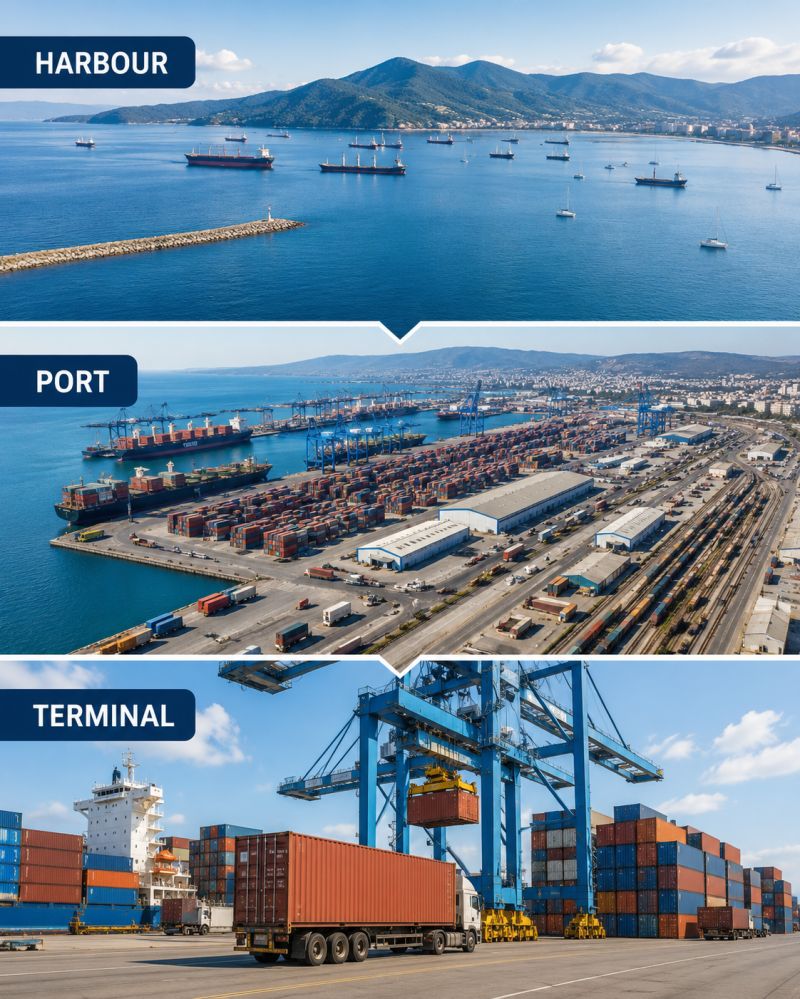
Understanding the difference can make conversations with suppliers, freight forwarders and customers much clearer. It isn’t just about terminology, it helps businesses communicate more clearly and avoid misunderstandings.
There is more to a destination than a location name, if you’re shipping to Rotterdam you may need to specify which harbour, which port and which terminal.
Rotterdam is the largest port in Europe and consists of multiple distinct harbours, some of these contain multiple ports and terminals within them. So Waalhaven harbour area in the port city of Rotterdam, has multiple ports including Waalhaven Zuid, which has a terminal called EBS European Bulk Services.
A ship enters a harbour, safe from the sea, it docks in the port where it’s terminal is for loading and unloading.
A port can include multiple terminals, customs facilities, warehouses, roads and rail connections, storage areas, logistics services etc.
A terminal is a specific facility inside a port, it’s where the actual cargo operations happen, containers are loaded and unloaded, trucks arrive, goods are stored temporarily before continuing their journey, customs inspections take place etc.
Shipping Logistics Errors
The Malaga Error is one example where documentation errors can lead to expensive mistakes, a food shipment destined for Malaga, Australia, was route to Malaga, Spain due to the bill of lading simply stating Malaga without the country code. As a result the container sailed across the oceans to the wrong continent, before a Change of Destination request and significant delay.
One of the most common shipping logistics errors is use of a general name. Using Southampton as an example, ships may anchor in Southampton Water (the harbour), clear customs at the Port of Southampton, and unload at DP World Southampton – these are three different references in the same paperwork, all meaning different physical/legal locations. Just entering Southampton in the documentation, can cause confusion.
Modern bills of lading now require UN/LOCODE (e.g., NLRTM for Rotterdam, AUSYD for Sydney/Port Botany) to prevent generalization errors.
Nuveca offers support with preparing shipping logistics documentation, contact us today with your requirements.
Port, Harbour, Terminal, Dictionary Definitions
Harbour is a place on the coast where vessels can find shelter, somwhere protected from rough water by natural features, piers, jetties, and other structures.
Port is the place where ships meet the land, though the dictionary definition is a town by the sea or on a river, which has a harbour, where ships can load and unload goods or passengers.
Terminal is the area in which cargo and containers are prepared for loading and unloading.
Key distinctions are that a harbour is primarily about shelter/protection for vessels; a port adds the commercial/operational aspect of loading/unloading cargo and passengers; a terminal is a specific facility within a port where the actual transfer operations take place.
The harbour is generally bigger than the port, it’s the area of sheltered water (natural or artificial) that provides protection from the open sea.
The port is the operation – it’s the commercial area where ships dock to load/unload cargo and passengers. The port uses the harbour’s protected waters, but also includes the land-based infrastructure (warehouses, cranes, roads, customs facilities, etc.) and the shipping terminals.